Mwita's Journey: From Student to Professor and Community Leader
Korogati Primary school was officially established in 1997 in my own village of Korogati. The school was started because there was no nearby pre-and upper primary school (grade school) which children who needed to start school in this village could go to. All other neighboring schools were miles away and often inaccessible for children of my age at that time. When it rained, rivers flooded, bridges sunk, paths got mudded, and it would take weeks before all this mess was cleared for children from Korogati village to access any neighboring school. These conditions pushed a few parents with school going children to demand a school in Korogati village.
A few families, including my own, offered to volunteer some sections of their land to start a school. I, kids in my immediate and extended family, as well as kids from other families in the village were the first learners in Korogati pre-school in January 1997. In our first two years, we were taught by one untrained volunteer teacher who had finished secondary school education but could not proceed to college. Parents in my village urged him to help, and I will forever be grateful to him that he agreed to help, and I am not sure if he was even paid anything for his service. He taught us every subject – from Mathematics to English and Swahili language, from Science to Christian Religious Education. He taught everything.
In the first two years of my early education at this institution, there was no physical building. Our determined parents identified a huge tree with a wide canopy which provided a well-spread shade. The small bushes under that tree were cleared and cleaned, and the shade of that tree became our first classroom. Our determined parents also acquired a portable black wall which we made to lay by the big tree for our teacher to write on. We sat on the ground under the shade – no seats – while the teacher taught. Things were always okay when there was no rain at any time during the day. But occasionally there would huge down pours. When this happened, we carried our only black wall and ran to shelter in a nearby homestead. Including our teacher. When the rain ended and the teacher determined that we could go back to class, we usually carried our black wall back to under the tree to continue learning. Occasionally, it would be undesirable to go back to class because of how muddy under the tree was, so, we would just decide to go home.
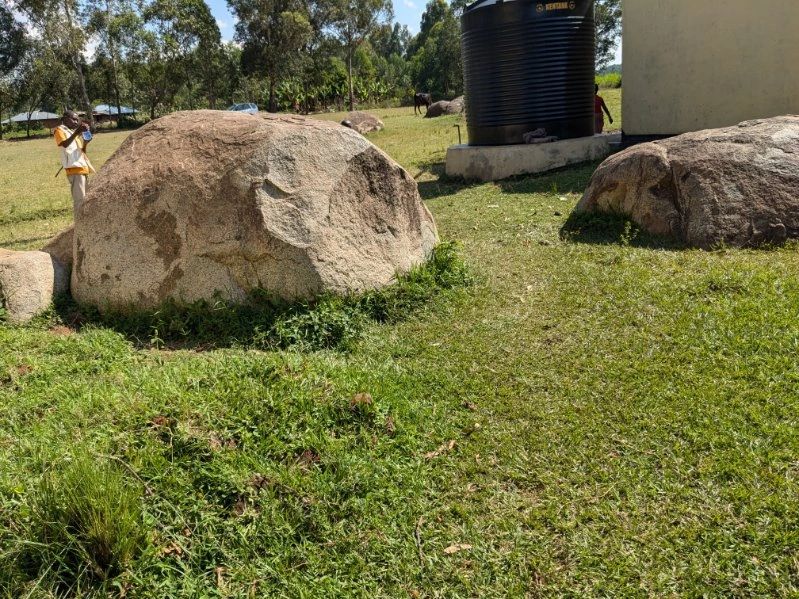
My class moved from pre-school and started Class One (then called Standard One) in 1998. There still was no physical building. We were forced to move from under our cherished tree to pave way for the incoming pre-school class. We found a space beside a huge rock (pictured below) and moved our portable black wall there. That became our class space for that year, with the same teacher who now moved between my class and the pre-school class. Same things happened when it rained – seek shelter, come back to class, or see you tomorrow.
It was not until early 1999 when my elder brother, then a newly college professor in Kenya, brought together a few of his friends, rallied parents in the village, and together, they conducted a fundraising that helped build the first mud-walled building (and a pit latrine for the first time) which provided an office space for the two teachers that we now had, and two classrooms. With two classroom spaces available, three classroom spaces needed, we had to rotate classroom usage. Class One would go out to play when Class Two is taught and vice versa. Our parents, my father leading the way, pressured the Ministry of Education to register the school.
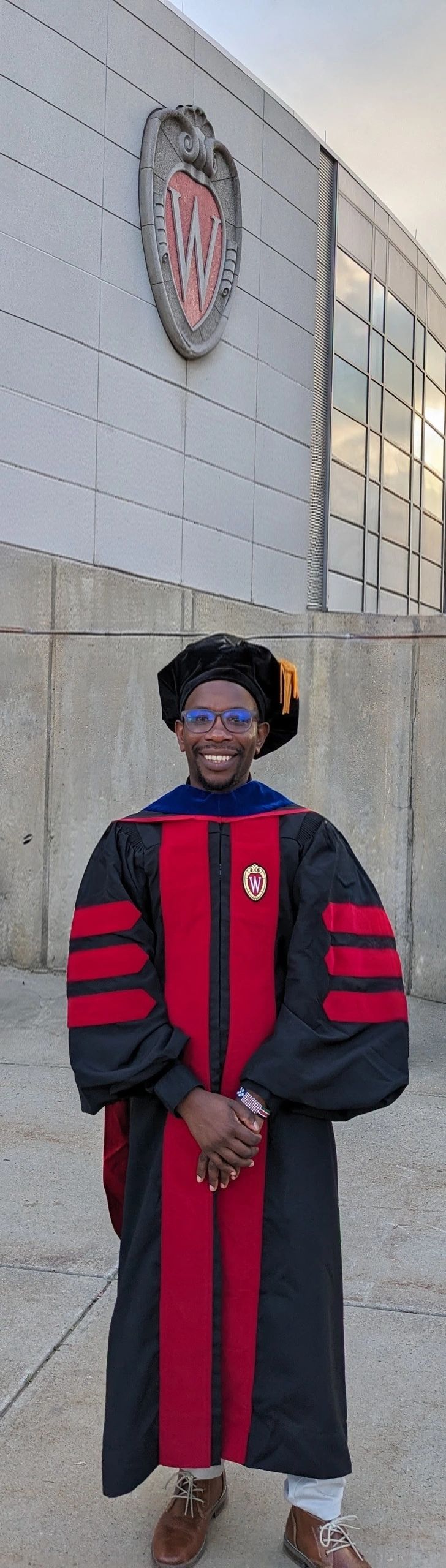
The Ministry of Education reluctantly registered our school, sent one trained teacher to come there, but he eventually did not stay longer because of the conditions he found us in. It took a few more years for more mud-walled classes to be built and the teachers from the ministry to stay. I graduated with distinction from this school, went to a well renown, high-achieving High School in the region in 2006, went to Moi University to pursue Bachelor of Arts in Swahili Language & Literature in 2011, graduated from Moi University with a First Class Honors in 2015, went to the University of Wisconsin-Madison in the United States for my graduate studies in 2017, and I am now an Assistant Teaching Professor at Oklahoma State University.
Many of my classmates from this school did not go to high school because of inadequate financial resources in their families. After completing primary school, many of them got married and immediately started families and peasant farming.
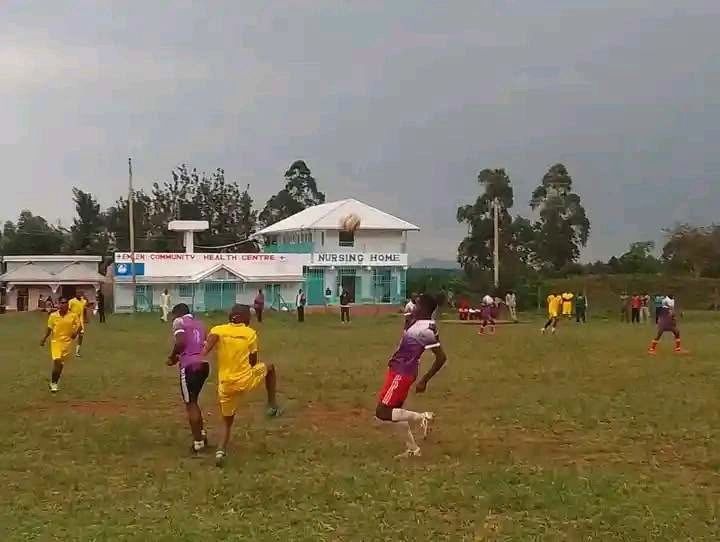
Korogati Football/Club (also known as Korogati Blue Stars FC) was started a few years ago by a group of my former classmates from Korogati primary School. It started as a group of a few young men who just wanted to exercise their bodies in the afternoon after a hard morning work in the farm using a ball they had knitted from plastic paper bags. Rather than stay idle the rest of the afternoon, which may result in unwanted behaviors like alcoholism or various forms of violence, they found playing soccer a useful way to use their time, creating community and unity among themselves. They later contributed some money and bought a rubber ball. A lot more young people began getting interested, and soon it soon grew into a local team. The group then requested to use the Korogati primary school playground for their practice, which the school granted. Young women saw what young men were doing, formed a team of their own and joined the club. The club, though still not formally registered with the Ministry of Sports in Kenya, is now fully developed with twenty-four players in each team, males and females.
When my wife and I visited Korogati village in the Summer of 2024, the teams requested for a meeting with me, which I did (pictured). Although I know my own journey from that environment more than anyone else, they reminded me how far I came and indicated how I am an inspiration not just to them but their children and the whole community. But they had one major request: Please be our Club Patron! I found it difficult to turn down their request. Since Summer 2024, my elder brother and I have been supporting the club’s activities including a few basics like soccer balls, offering small funds for their soccer competitions/ tournaments with other local clubs, facilitating friendly matches etc. The club has been appealing to me to officially launch and register them and help them acquire necessary materials which are beyond their reach. I am appealing to my friends for material as well financial support towards this course and help me to not only support the club but also give back to the community which brought me this far.
Mwita's Vision: Empowering the Next Generation through Football and Education
Mwita's journey began as the first student at Korogati Primary School, where he discovered the power of education to change lives. Growing up in a community where opportunities were scarce, he understood firsthand the importance of creating pathways for youth. He believes that through sports and education, youth can build character, learn teamwork, and develop essential life skills. Every match played and every goal scored is a step toward a brighter future, not just for the athletes, but for the entire Korogati community.
As Mwita pursued higher education and became a professor in the United States, his commitment to Korogati remains steadfast. He envisions a future where local youth and young adults could thrive, equipped with both educational and athletic opportunities. By combining sports development with a focus on education, Mwita aims to cultivate well-rounded individuals who can give back to their community in meaningful ways. His dream is to establish a nonprofit that ensures sustainable support for Korogati Football Club and its programs, paving the way for generations to come. Join us in turning this vision into reality—support youth soccer in Kenya and help us create lasting change in Korogati village.